Consistent Hashing: The Algorithm Behind Every Scalable Distributed System
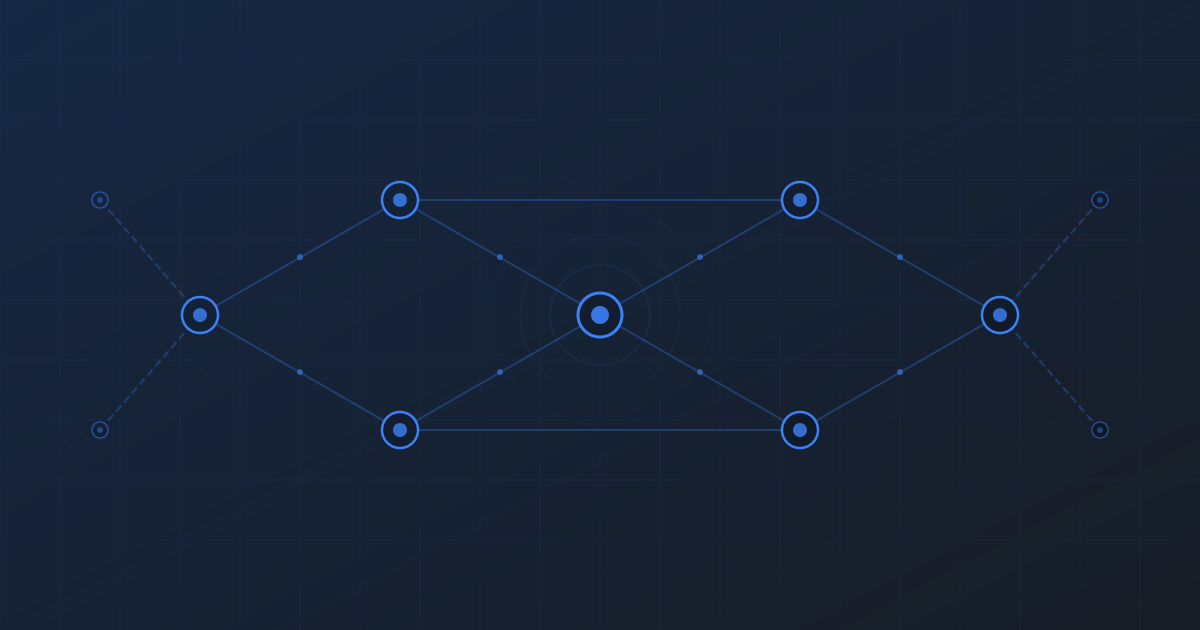
Adding one cache server shouldn't invalidate every key. Consistent hashing with virtual nodes and bounded loads — full Go and Java implementations.
Master the art of designing large-scale distributed systems. From load balancing to database sharding, learn how to build scalable, reliable, and maintainable backend architectures.
A complete roadmap to understanding core concepts: CAP theorem, consistent hashing, consensus, idempotency, and resilience patterns.
Decomposing monoliths, inter-service communication (gRPC, REST, GraphQL), event-driven patterns, and managing distributed transactions.
Adding one cache server shouldn't invalidate every key. Consistent hashing with virtual nodes and bounded loads — full Go and Java implementations.
Probabilistic drop rate limiting: uncoordinated enforcement bypassing Redis for 1M+ RPS with zero coordination overhead.
Every DNS record type for production: A, CNAME, MX, TXT, CAA, SRV. TTL failover math, SPF/DKIM/DMARC, GeoDNS, and DNSSEC.
How HTTP evolved from sequential text to multiplexed binary streams over QUIC. What each version solves and when to upgrade.
When to decompose a monolith, how to define boundaries, and the patterns that work: API gateways, sagas, and event-driven comms.
Kafka vs RabbitMQ vs NATS vs SQS: delivery semantics, ordering, throughput, ops complexity, and a decision framework with Go code.
Five rate limiting algorithms, their trade-offs, how to distribute them across a fleet, and client-side backoff that works.
How a team serving mobile, microservices, and third-party integrations ended up running REST, gRPC, and GraphQL together.
OAuth2 flows with PKCE, refresh token rotation, theft detection, and JWT vs opaque token security tradeoffs for production.
Circuit breakers, bulkhead isolation, timeout propagation, and idempotent retries in Go — the patterns for surviving component failures.