Java Streams: Pipeline Internals, Performance Traps, and Production Patterns

Lesson 3 of 6
14 seconds for one quarterly revenue report — three passes over the same dataset. The method was 200 lines of nested loops and intermediate
HashMaps, a separate pass for each aggregation. The streams rewrite collapsed to ~35 lines: three pipelines, each doing one aggregation, feeding a singleteeing()collector[1]. It runs in 2 seconds.
The value proposition of Java Streams isn't speed — it's composable data pipelines where each stage has a single responsibility. Not shorter code, but maintainable code. This guide covers pipeline fusion, where streams win vs where loops are clearer, and the patterns that matter in production.
Stream pipeline fusion avoids intermediate collections by fusing multiple operations into one pass. Use streams for multi-stage transformations; use loops for index-dependent logic or small collections. Always use primitive streams (IntStream, LongStream) for numeric work — boxed Stream<Integer> runs roughly an order of magnitude slower than IntStream on large numeric sums because of per-element allocation (the Performance section has a JMH skeleton to measure it). Parallel streams add overhead; only parallelize when N*Q > 10,000 and the source is easily splittable.
- Understand pipeline fusion: filter → map → collect becomes a single fused operation
- Master collectors: use
groupingBy(),teeing(), andCollector.of()for complex aggregations - Know the performance cliffs: boxing on numeric streams (an order-of-magnitude cost — benchmark it yourself with JMH), materialization (sorted), and parallel overhead
How Stream Pipelines Work
When you chain .filter().map().collect(), the JVM does not materialize intermediate collections[1]. Instead, it builds a fused pipeline: a single Sink chain that processes elements one at a time.
graph LR
    subgraph Loop["Loops: each pass materialises a list"]
        L0[orders] -->|pass 1: filter| L1[(Filtered list)]
        L1 -->|pass 2: map| L2[(Email list)]
        L2 -->|pass 3: filter| L3[("@company list")]
        L3 -->|pass 4: distinct| L4[(Unique set)]
    end
    subgraph Stream["Stream: each element flows through all stages"]
        S0[orders] -->|element| F1[filter status]
        F1 -->|element| F2[map → email]
        F2 -->|element| F3["filter @company"]
        F3 -->|element| F4[distinct]
        F4 -->|element| Out[(toList)]
    end
    style L1 fill:#fee
    style L2 fill:#fee
    style L3 fill:#fee
    style L4 fill:#fee
    style Out fill:#efe
The loop variant pays for four full passes plus four intermediate allocations. The stream variant pays for one pass and one final allocation. That's pipeline fusion — and it's why streams scale on large inputs even when a hand-rolled loop is slightly faster on small ones.
// This creates zero temporary lists
List<String> result = orders.stream()
    .filter(o -> o.getStatus() == Status.COMPLETED)    // fused stage 1
    .map(Order::getCustomerEmail)                       // fused stage 2
    .filter(email -> email.endsWith("@company.com"))    // fused stage 3
    .distinct()                                          // fused stage 4
    .toList();                                           // terminal: trigger fused pipeline
Each element flows through all four stages before the next element enters. No temporary ArrayLists, no redundant passes. This pipeline fusion is why streams scale.
Lazy evaluation means nothing runs until the terminal operation (toList(), findFirst(), collect())[1]. Short-circuiting means terminals like findFirst() can stop early:
Optional<Order> found = orders.stream()
    .filter(o -> o.getTotal() > 10_000)                 // lazy
    .map(o -> enrichData(o))                            // not called until needed
    .findFirst();                                        // stops after first match
If the third element matches, enrichData() is called exactly three times. The remaining 999,997 elements are untouched.
sorted() must see all upstream elements before emitting the first one. Avoid placing it before short-circuiting
terminals — use min() or max() instead of sorted().findFirst().
Common Operations and Their Hidden Costs
The cost model in one table — most stream surprises come from operations in the right column:
| Operation | Lazy? | Cost on N elements | Common pitfall |
|---|---|---|---|
filter, map, peek | Yes | O(N), one-pass | None — these are the cheap composable building blocks |
findFirst, findAny | Short-circuits | O(K) where K is index of match | None when stream is properly lazy |
count, forEach, collect | Terminal | O(N) | Triggers evaluation of the whole pipeline |
sorted() | Eager | O(N log N) + O(N) memory | Breaks short-circuiting — sorted().findFirst() materialises everything |
distinct() | Stateful | O(N) memory for hash set | Memory cost on large streams; ordering retained |
flatMap | Per-element eager | Each sub-stream fully consumed | flatMap.findFirst does NOT short-circuit across sub-streams |
reduce (parallel) | Parallel-friendly | O(N/P + log P) | Identity must be a true identity; combiner must be associative |
parallelStream() | N/A | Splittability + Q matter | NQ < 10000 → fork-join overhead dominates |
sorted() and flatMap() break lazy evaluation in different ways:
sorted() materializes everything:
// Efficient: one-pass, short-circuits after first match
orders.stream()
    .filter(o -> o.getTotal() > 100)
    .findFirst();

// Inefficient: materializes entire filtered set into array before finding first
orders.stream()
    .filter(o -> o.getTotal() > 100)
    .sorted(Comparator.comparing(Order::getTotal))
    .findFirst();  // sorted() already consumed everything
Use min() or max() instead of sorted().findFirst() — they run O(n) without materialization.
flatMap() consumes sub-streams eagerly:
// Each department list fully consumed before next department
Optional<Employee> found = departments.stream()
    .flatMap(dept -> dept.getEmployees().stream())  // entire sub-stream consumed
    .filter(e -> e.getName().equals("Alice"))
    .findFirst();  // too late; already processed all employees
Never rely on peek() with short-circuiting — it may skip elements in parallel streams or observe elements in unpredictable order. Use a proper side-effect collector instead.
Collector Patterns
Collectors compose to solve complex aggregations in a single pass. Three patterns cover most production code:[1]
Downstream collectors with groupingBy():
// Group by status, compute average per status
Map<Status, Double> avgByStatus = orders.stream()
    .collect(Collectors.groupingBy(
        Order::getStatus,
        Collectors.averagingDouble(Order::getTotal)
    ));

// Multi-level grouping: department → seniority → count
Map<String, Map<Seniority, Long>> matrix = employees.stream()
    .collect(Collectors.groupingBy(
        Employee::getDepartment,
        Collectors.groupingBy(
            Employee::getSeniority,
            Collectors.counting()
        )
    ));
teeing() for dual aggregations:
record PipelineResult(List<Order> valid, List<String> errors) {}

// Single pass: separate valid/invalid and collect both
PipelineResult result = orders.stream()
    .collect(Collectors.teeing(
        Collectors.filtering(Order::isValid, Collectors.toList()),
        Collectors.filtering(o -> !o.isValid(),
            Collectors.mapping(Order::getError, Collectors.toList())),
        PipelineResult::new
    ));
Custom collectors with Collector.of():
// Batch records for bulk insert
public static <T> Collector<T, ?, List<List<T>>> toBatches(int size) {
    return Collector.of(
        ArrayList::new,
        (batches, item) -> {
            if (batches.isEmpty() || batches.getLast().size() >= size) {
                batches.add(new ArrayList<>());
            }
            batches.getLast().add(item);
        },
        (left, right) -> { left.addAll(right); return left; }
    );
}

// Usage
records.stream()
    .filter(Record::isValid)
    .collect(toBatches(500))
    .forEach(batch -> repository.bulkInsert(batch));
Use reduce() only for simple same-type operations (sum, max, min). For everything else, use collectors.
Performance: where the cliffs are
Streams carry a small overhead for simple filter-map-collect pipelines due to Sink indirection — usually negligible against the work the pipeline does. But the biggest performance cliff is boxing, and it's structural: a Stream<Integer> allocates a boxed Integer object per element, while IntStream works on primitives with no allocation[1]. On a tight numeric aggregation, that's the difference between a heap allocation + cache miss per element and a register operation.
The shape to expect on a 1M-element numeric sum — verify it on your own JVM with the JMH skeleton below:
Benchmark                    (size)   Boxed     Primitive   Loop
summing integers            1M       ~10s of ms  ~sub-ms     ~sub-ms
Stream<Integer> is roughly an order of magnitude slower than IntStream for numeric aggregation. The penalty varies by operation and JVM — simple sums show the worst case because IntStream.sum() is heavily JIT-optimized, while boxed streams force heap allocation and GC pressure on every element[1]. The exact multiplier is the kind of thing you should never take from a blog: measure it.
// JMH: prove the boxing penalty on your own JVM.
// @Benchmark long boxed()    { return boxed.stream().mapToLong(Integer::longValue).sum(); }
// @Benchmark long primitive(){ return IntStream.range(0, N).asLongStream().sum(); }
// Run with: mvn -q exec:exec -Dexec.args="-prof gc"  (watch alloc rate, not just time)
Always use primitive streams for numeric work:
// Bad: Stream<Integer> boxing penalty
long sum = integers.stream().mapToInt(Integer::intValue).sum();

// Good: IntStream, no boxing
long sum = IntStream.of(1,2,3,4).sum();
When to use loops instead of streams:
- Small collections (< 100 elements): pipeline setup cost exceeds computation
- Index-dependent logic:
IntStream.range()is awkward for positional operations - Complex side effects: manual iteration is clearer than
forEach
Parallel Streams: The NQ Model
Parallel streams add fork-join overhead that only pays off at scale. Use the NQ model: parallelism helps when N * Q > 10,000, where N is element count and Q is work per element.[1]
The decision flow — route by symptom, not by "I want it faster":
graph TD
    Start[Stream pipeline<br/>is a bottleneck] --> Cost{Per-element<br/>cost Q?}
    Cost -->|Q is tiny<br/>arithmetic, get| Sequential1[Stay sequential<br/>fork-join overhead<br/>dominates]
    Cost -->|Q is real<br/>I/O, parsing, hashing| Size{Element<br/>count N?}
    Size -->|N small<br/>under 1000| Sequential2[Stay sequential<br/>NQ under 10000]
    Size -->|N large<br/>or NQ over 10000| Split{Source<br/>splittable?}
    Split -->|ArrayList, array,<br/>IntStream.range| Pool{Shared<br/>ForkJoinPool ok?}
    Split -->|LinkedList, BufferedReader,<br/>iterator| Sequential3[Stay sequential<br/>splitting overhead<br/>kills parallelism]
    Pool -->|Yes, short ops<br/>under 10ms each| ParallelDefault[parallelStream]
    Pool -->|No, long ops<br/>or pool starvation risk| ParallelCustom[Custom ForkJoinPool<br/>+ submit + join]
    style Sequential1 fill:#fdd
    style Sequential2 fill:#fdd
    style Sequential3 fill:#fdd
    style ParallelDefault fill:#dfd
    style ParallelCustom fill:#ffd
The diagram is the cheat sheet — three reasons to stay sequential, two ways to go parallel. Most parallelisations are wrong because they skip the splittability and pool-isolation checks.
N=100, Q=1 → NQ=100 → sequential (18x faster for parallel overhead at this size)
N=1M, Q=1 → NQ=1M → parallel wins (3-4x speedup on 4-core machine)
The shared ForkJoinPool trap: All parallel streams use the common ForkJoinPool[1] by default. A long-running stream starves others:
// Starves the pool; other parallel streams hang
List<Result> results = hugeDataset.parallelStream()
    .map(item -> expensiveWork(item))  // 100ms per item
    .toList();

// Workaround: custom isolated pool
ForkJoinPool pool = new ForkJoinPool(4);
List<Result> results = pool.submit(() ->
    hugeDataset.parallelStream()
        .map(item -> expensiveWork(item))
        .toList()
).join();
Splittability matters: ArrayList and IntStream.range() split cleanly. LinkedList and BufferedReader do not. Thread safety is mandatory: operations must be stateless and side-effect-free. Use collectors, not forEach + shared state.
Start sequential. Parallel streams are an optimization, not a default. Profile first; only parallelize after identifying a stream pipeline as a genuine bottleneck and verifying the data size and operation cost justify fork-join overhead.
ETL and Aggregation Examples
Batching for bulk insert:
public int processCSV(Path csvFile) throws IOException {
    try (Stream<String> lines = Files.lines(csvFile)) {
        return lines
            .skip(1)  // header
            .map(line -> line.split(",", -1))
            .filter(cols -> cols.length >= 5)
            .map(cols -> new Record(cols[0].trim(), cols[1].trim(), ...))
            .filter(Record::isValid)
            .collect(toBatches(500))
            .stream()
            .mapToInt(batch -> repository.bulkInsert(batch))
            .sum();
    }
}
Dual aggregation with teeing():
record Report(List<Order> valid, List<String> errors) {}

Report result = orders.stream()
    .collect(Collectors.teeing(
        Collectors.filtering(Order::isValid, Collectors.toList()),
        Collectors.filtering(o -> !o.isValid(),
            Collectors.mapping(Order::getError, Collectors.toList())),
        Report::new
    ));
Multi-level grouping:
Map<String, Map<String, Long>> report = entries.stream()
    .collect(Collectors.groupingBy(
        Entry::getUser,
        Collectors.groupingBy(
            Entry::getAction,
            Collectors.counting()
        )
    ));
Production Checklist
- Use primitive streams (IntStream, LongStream) for numeric aggregations — boxing costs roughly an order of magnitude on numeric sums (see the Performance section; benchmark your own)
- Avoid
sorted()beforefindFirst()— usemin()ormax()instead - Chain operations in a single pipeline; avoid intermediate
collect()calls - Use
groupingBy()andteeing()for complex aggregations, notforEach+ mutable state - Never use
flatMap()for side effects; use the returned stream's elements - Parallel streams require N*Q > 10,000; use a custom ForkJoinPool if needed for isolation
- Test with actual data size and operation cost before parallelizing
- Chains of collectors compose cleanly;
Collector.of()for custom accumulation
Gatherers: The Missing Intermediate Operation
For years the standard library shipped a fixed set of intermediate operations — filter, map, flatMap, distinct, sorted, peek, limit, skip — and a custom one was impossible without dropping into Spliterator. JEP 461 introduced Gatherers as preview in Java 22 and refined them in Java 23, exposing the same extension point for intermediate stages that Collector exposes for terminals.
A Gatherer carries an initializer, an integrator, an optional combiner for parallel pipelines, and a finisher; the integrator decides whether each element is emitted, dropped, or buffered, and whether the upstream should keep flowing. That is enough machinery to implement windowing, deduplication with a custom equality, scan-style running aggregates, and any other stage where output cardinality differs from input cardinality.
A sliding window of three is a one-liner with the built-in factory:
import java.util.stream.Gatherers;

List<List<Integer>> windows = Stream.of(1, 2, 3, 4, 5, 6)
    .gather(Gatherers.windowSliding(3))
    .toList();
// [[1,2,3],[2,3,4],[3,4,5],[4,5,6]]
A running balance is a built-in scan, and a custom rate-limit gate is roughly twenty lines of integrator. The thing to remember is that a Gatherer is a stateful intermediate; ordering matters, parallelism may serialize through your gather stage, and you should benchmark before reaching for it on hot paths. Until your team is on Java 22+ with preview features enabled, the same shapes are achievable with custom collectors plus a final stream over the result.
Custom Collectors Beyond toList
The four-arg form of Collector.of takes a supplier, accumulator, combiner, and optional finisher, plus characteristics that tell the runtime whether the collector is concurrent, unordered, or identity-finishing. Most teaching examples stop at toBatches; production reporting code routinely needs collectors that track multiple running statistics and emit a record at the end. Welford's algorithm for numerically stable variance is a good worked example because it is genuinely stateful, the combiner is non-trivial, and the result is a record rather than a collection:
record Stats(long count, double mean, double variance) {}

public static Collector<Double, ?, Stats> toStats() {
    class Acc { long n; double mean; double m2; }
    return Collector.of(
        Acc::new,
        (acc, x) -> {
            acc.n++;
            double delta = x - acc.mean;
            acc.mean += delta / acc.n;
            acc.m2 += delta * (x - acc.mean);
        },
        (left, right) -> {
            if (left.n == 0) return right;
            if (right.n == 0) return left;
            long n = left.n + right.n;
            double delta = right.mean - left.mean;
            Acc out = new Acc();
            out.n = n;
            out.mean = left.mean + delta * right.n / n;
            out.m2 = left.m2 + right.m2 + delta * delta * left.n * right.n / n;
            return out;
        },
        acc -> new Stats(acc.n, acc.mean, acc.n > 1 ? acc.m2 / (acc.n - 1) : 0.0),
        Collector.Characteristics.UNORDERED
    );
}
The combiner is the part most people get wrong. A naive implementation that re-runs the accumulator on the right side's elements works sequentially but silently produces incorrect variance under parallelStream. Mark the collector UNORDERED only when ordering genuinely does not affect the result; mark it CONCURRENT only when the accumulator is thread-safe and the supplier returns a shared mutable container. Both characteristics let the runtime skip work, and both are wrong defaults to copy from a tutorial.
Teeing for Single-Pass Parallel Aggregation
Collectors.teeing fans the stream into two downstream collectors and merges their results once at the end, which makes it the right primitive when a report needs several aggregates from the same dataset and you do not want to traverse the source twice. The pattern composes: a teeing of a teeing of a teeing collects four metrics in one pass, and each leaf can itself be a groupingBy or a custom collector. Under parallelStream both branches see the same partitioning, so the cost is dominated by the heavier branch rather than the sum, which is the whole point.
record DailyReport(double total, double average, long highValue, Map<Status, Long> byStatus) {}

DailyReport report = orders.parallelStream()
    .collect(Collectors.teeing(
        Collectors.teeing(
            Collectors.summingDouble(Order::getTotal),
            Collectors.averagingDouble(Order::getTotal),
            (sum, avg) -> new double[] { sum, avg }
        ),
        Collectors.teeing(
            Collectors.filtering(o -> o.getTotal() > 10_000, Collectors.counting()),
            Collectors.groupingBy(Order::getStatus, Collectors.counting()),
            (count, byStatus) -> new Object[] { count, byStatus }
        ),
        (sumAvg, countMap) -> new DailyReport(
            sumAvg[0], sumAvg[1],
            (long) ((Object[]) countMap)[0],
            (Map<Status, Long>) ((Object[]) countMap)[1]
        )
    ));
The boxing into double-arrays and Object-arrays is ugly; in production code, define small intermediate records for each pair so the merge function does not lean on casts. When the aggregates need to flow into a database row, prefer two top-level collectors and a record constructor that accepts both, rather than nesting teeing more than two layers deep — the readability cliff is steep.
Streams and Optional: Anti-Patterns
Optional was designed for return types where absence is meaningful, not as a general null replacement and not as a stream collaborator. Several patterns look reasonable in isolation and quietly hide bugs:
// Anti-pattern 1: Optional.get without checking. Throws on absent.
String name = users.stream()
    .filter(u -> u.getId() == userId)
    .findFirst()
    .get();

// Better: orElseThrow with a typed exception that says what was missing.
String name = users.stream()
    .filter(u -> u.getId() == userId)
    .findFirst()
    .map(User::getName)
    .orElseThrow(() -> new UserNotFoundException(userId));

// Anti-pattern 2: Optional<List<T>>. Empty list already encodes absence.
public Optional<List<Order>> findOrders(long userId) { ... }

// Better: return List<T>, empty when there are none.
public List<Order> findOrders(long userId) { ... }

// Anti-pattern 3: Optional fields on records or entities.
record User(long id, String name, Optional<String> email) {}

// Better: nullable field, Optional only at the access boundary.
record User(long id, String name, String email) {
    public Optional<String> email() { return Optional.ofNullable(email); }
}
The fourth pitfall is using stream().filter().findFirst() when the source is a Map. Calling map.get(key) followed by Optional.ofNullable is O(1); streaming through the entry set to find a matching key is O(n) and a hot spot in profilers. Reach for streams when the shape of the work is a transformation pipeline, not as a default lookup style.
Frequently Asked Questions
Why use streams if they're sometimes slower than loops?
Streams are not a performance tool — they're a composability tool. The real win is pipeline fusion: five chained operations become one fused operation processing elements once, with zero intermediate collections. Readability and maintainability matter more than 5-8% overhead on simple pipelines. [1]
When should I use IntStream vs Stream<Integer>?
Always use IntStream for numeric work. On a large numeric array, summing through Stream<Integer> runs roughly an order of magnitude slower than IntStream because every int is wrapped in an Integer object, causing heap allocation and GC pressure on every element. The penalty varies by operation and JVM — the Performance section has a JMH skeleton to measure it on yours.
Is parallel streams the answer to slow stream pipelines?
No. Parallel streams add fork-join overhead that only pays off when N*Q > 10,000 (number of elements times work per element). Most stream pipelines are too small or operate on non-splittable sources (LinkedList, BufferedReader). Profile first; parallelize last.
What's the difference between sorted() and min()/max()?
sorted() materializes the entire upstream into an array before emitting the first element, breaking lazy evaluation. min() and max() run in O(n) with no materialization — use them instead of sorted().findFirst().
Why does my parallel stream cause other parallel streams to hang?
By default, all parallel streams share the common ForkJoinPool. A long-running stream starves the pool for other parallel work. Workaround: submit to a custom ForkJoinPool with explicit thread count and isolation.
Should I use flatMap or nested streams in filter?
Use flatMap when you need the sub-elements themselves. Nested streams in filter are acceptable for condition checks (anyMatch, allMatch). Nested streams force sub-stream creation per element — flatMap is cleaner when extracting multiple items per parent.
Keep Reading
- Modern Java Collections: computeIfAbsent, Immutables, and Best Practices — Collection APIs that feed stream pipelines
- Java CompletableFuture: Async Orchestration Patterns for Production — When your pipeline needs async I/O instead of in-memory transformation
- Modern Java Features: A Practical Guide from Java 8 to 21 — Records and sealed classes that pair with stream pipelines
- Java Virtual Threads: Project Loom — When parallelStream is the wrong tool: virtual threads handle blocking I/O without the ForkJoinPool starvation trap
- Java Date/Time API Guide — Streams over
Instant/ZonedDateTimefor time-bucketed aggregations
Sources
- 1.java.util.stream — Package Summary (Java Platform SE) — Oracle Java Documentation, 2026
Engineering Team
An independent engineering publication covering distributed systems, databases, and production infrastructure. Every factual claim is cited to a primary source or removed.
Read Next

Modern Java Collections: computeIfAbsent, Immutables, and Best Practices
Java collections: computeIfAbsent, getOrDefault, removeIf, immutables, and Comparator chains that eliminate entire bug categories.
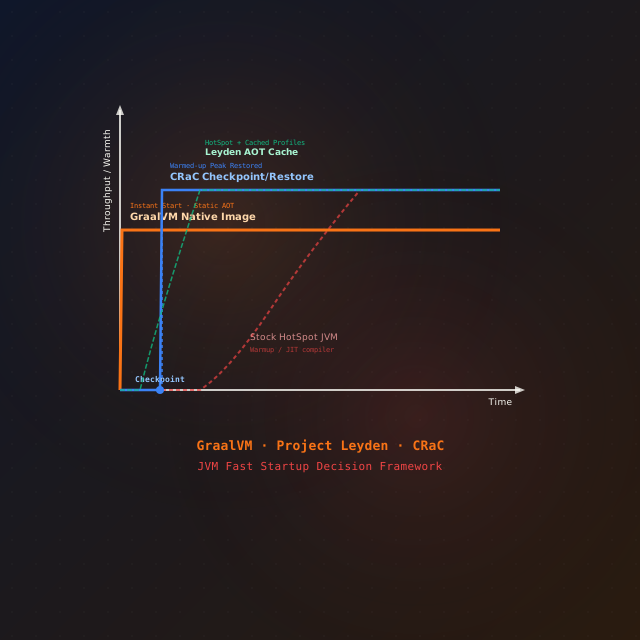
JVM Cold Start in 2026: Leyden vs GraalVM Native Image vs CRaC
Slow JVM cold start breaks scale-to-zero and autoscaling. Three ways to fix it in 2026 — Project Leyden's AOT cache, GraalVM Native Image, and CRaC — with the exact commands, the trade-offs, and a decision framework.

Java Date and Time API: The Definitive Guide to java.time
Stop fighting java.util.Date. Master LocalDateTime, ZonedDateTime, Instant, and Duration — predictable, thread-safe time handling.