Caching Strategies at Scale: Beyond Simple Key-Value Stores

BackendBytes Architect Team
System Architecture Group•
11 min read
Introduction
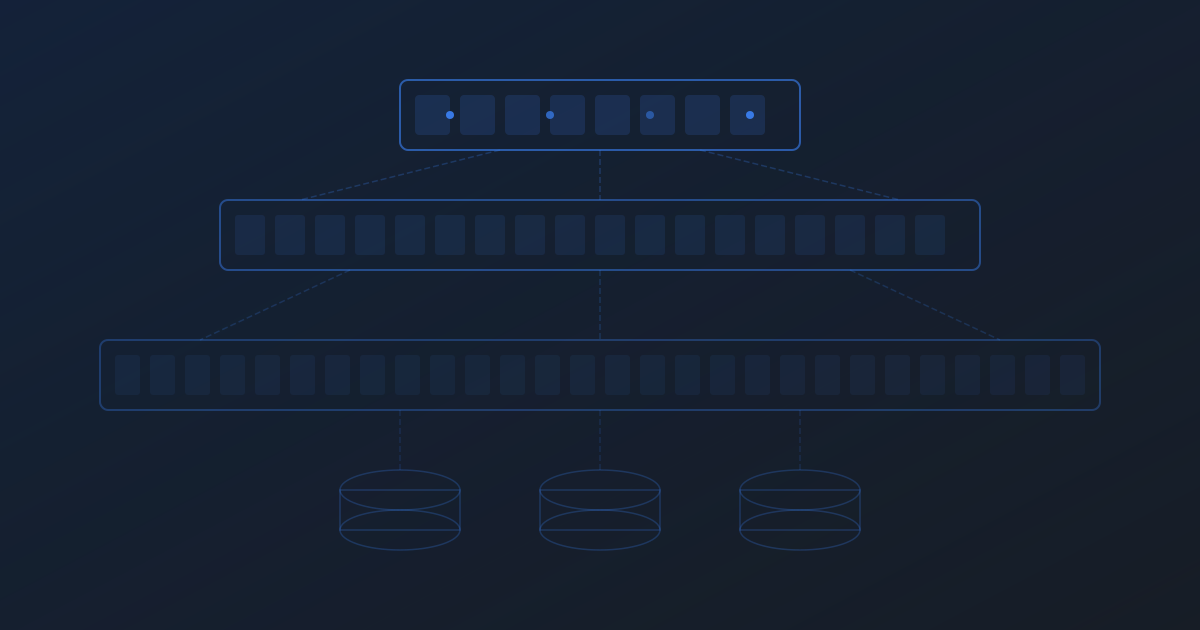
Caching is the backbone of every high-performance backend system, but naive caching leads to stale data, cache stampedes, and consistency nightmares. Let us explore patterns that work at scale.
Caching Patterns
There are four fundamental caching strategies, each with distinct trade-offs for consistency, latency, and complexity.
Cache-Aside (Lazy Loading)
The application is responsible for reading from and writing to the cache. On a cache miss, it reads from the database and populates the cache.
The application is responsible for reading from and writing to the cache. On a cache miss, it reads from the database and populates the cache.
sequenceDiagram
    participant App
    participant Cache
    participant DB

    App->>Cache: Get(Key)
    alt Cache Hit
        Cache-->>App: Value
    else Cache Miss
        Cache-->>App: nil
        App->>DB: Query()
        DB-->>App: Result
        App->>Cache: Set(Key, Result)
    end
func GetUser(ctx context.Context, id string) (*User, error) {
    // 1. Check cache first
    cached, err := cache.Get(ctx, "user:"+id)
    if err == nil {
        return deserialize(cached)
    }
    // 2. Cache miss -- fetch from database
    user, err := db.GetUser(ctx, id)
    if err != nil {
        return nil, err
    }
    // 3. Populate cache
    cache.Set(ctx, "user:"+id, serialize(user), 5*time.Minute)
    return user, nil
}
This is the most common pattern and works well for read-heavy workloads. The main drawback is that the first request after a cache miss or expiration is slow.
Write-Through
Every write goes to both the cache and the database synchronously. This ensures the cache is always consistent with the database but adds latency to writes.
Write-Behind (Write-Back)
Writes go to the cache immediately and are asynchronously flushed to the database. This provides the fastest write performance but risks data loss if the cache fails before flushing.
sequenceDiagram
    participant App
    participant Cache
    participant Queue as Msg Queue
    participant DB

    Note over App: Client Request
    App->>Cache: Set(Key, Value)
    App->>Queue: Publish(WriteEvent)
    App-->>App: Return 200 OK (Fast)

    loop Async Worker
        Queue->>DB: Batch Write
    end
// Write-Behind Implementation (Simplified)
func UpdateUserProfile(ctx context.Context, user User) error {
    // 1. Update Cache Immediately (Optimistic)
    err := cache.Set(ctx, "user:"+user.ID, user, 0)
    if err != nil {
        return err
    }

    // 2. Queue for async persistence
    // This returns almost instantly
    err = queue.Publish("db_writes", WriteEvent{
        Type: "UPDATE_USER",
        Data: user,
    })
    return err
}
Read-Through
Similar to cache-aside, but the cache itself is responsible for loading data on a miss. The application only talks to the cache, which talks to the database when needed.
Cache Stampede Prevention
A cache stampede occurs when a popular cache key expires and hundreds of requests simultaneously hit the database to reload it. There are several mitigation strategies.
func GetUserWithLock(ctx context.Context, id string) (*User, error) {
    cached, err := cache.Get(ctx, "user:"+id)
    if err == nil {
        return deserialize(cached)
    }

    // Acquire a distributed lock
    lockKey := "lock:user:" + id
    acquired, err := cache.SetNX(ctx, lockKey, "1", 10*time.Second)
    if err != nil || !acquired {
        // Another request is loading, wait and retry
        time.Sleep(100 * time.Millisecond)
        return GetUserWithLock(ctx, id)
    }
    defer cache.Del(ctx, lockKey)

    // Double-check cache (another request may have loaded it)
    cached, err = cache.Get(ctx, "user:"+id)
    if err == nil {
        return deserialize(cached)
    }

    user, err := db.GetUser(ctx, id)
    if err != nil {
        return nil, err
    }
    cache.Set(ctx, "user:"+id, serialize(user), 5*time.Minute)
    return user, nil
}
Redis Cluster for High Throughput
Single Redis instance tops out at roughly 100K operations per second. Redis Cluster shards data across multiple nodes using hash slots, providing linear scalability.
graph TD
    Client[Application]

    subgraph Cluster [Redis Cluster]
        N1["Node 1<br/>Slots 0-5460"]
        N2["Node 2<br/>Slots 5461-10922"]
        N3["Node 3<br/>Slots 10923-16383"]
    end

    Client -->|"CRC16 key mod 16384"| Hash{"Hash Slot"}
    Hash -->|"0-5460"| N1
    Hash -->|"5461-10922"| N2
    Hash -->|"10923-16383"| N3
rdb := redis.NewClusterClient(&redis.ClusterOptions{
    Addrs: []string{
        "redis-1:6379",
        "redis-2:6379",
        "redis-3:6379",
    },
    PoolSize:     100,
    MinIdleConns: 10,
    ReadOnly:     true,
    RouteByLatency: true,
})
Conclusion
Effective caching requires understanding your data access patterns, consistency requirements, and failure modes. Choose the right pattern for each use case and always plan for cache failures. A cache should improve performance, not become a single point of failure.
BackendBytes Architect Team
System Architecture Group
Experts in distributed systems, scalability, and high-performance computing.
Read Next
Medium
System Design•8 min read
Scaling Redis for High-Throughput Systems
When your distributed system hits 100k requests per second, your caching layer becomes the most critical component. Here's how to configure Redis Cluster for maximum resilience.
MicroservicesRedisSystem Design
Hard
System Design•12 min read
Building Resilient Distributed Systems with Go
Learn how to design and implement fault-tolerant distributed systems using Go's concurrency primitives, circuit breakers, and graceful degradation patterns.
GoDistributed SystemsResilience
Hard
System Design•16 min read
Understanding Raft Consensus: Building Blocks of Distributed Databases
A practical guide to the Raft consensus algorithm with Go implementation examples. Learn leader election, log replication, and safety guarantees.
Distributed SystemsRaftConsensus